
blog
PVYvault - why its the best choice
The Password Manager Industry Is in Crisis
If you've been paying attention to cybersecurity news lately, you know that the password management industry is facing a trust crisis of unprecedented proportions. Two of the most widely used password managers — LastPass and Bitwarden — have recently given their users serious reasons to reconsider where they store their most sensitive credentials.
LastPass: A Pattern of Breaches
LastPass has been hit by yet another data breach, this time through a supply chain attack on Klue, a third-party market intelligence platform. According to [BleepingComputer], hackers stole OAuth tokens that Klue held for its customers, including LastPass. These tokens were then used to access LastPass customer data stored in their Salesforce environment, exposing:
- Customer names
- Phone numbers
- Email addresses
- Physical addresses
- Support case information
- Sales/CRM-related data
The attack was claimed by the Icarus extortion group, who compromised Klue's infrastructure using legacy credentials and then exfiltrated CRM data across multiple affected organizations, including Recorded Future, Tanium, Jamf, Sprout Social, Gong, and Insurity.
But this isn't LastPass's first rodeo. The infamous 2022 LastPass data breach continues to haunt users years later. According to TRM Labs, stolen encrypted vault backups from that breach have enabled attackers to crack weak master passwords and drain cryptocurrency wallets as recently as late 2025, with thefts linked to more than 150 victims totaling over $35 million. LastPass settled a class action lawsuit for $24.5 million for losses incurred by customers whose vaults were accessed.
The lesson is clear: centralized cloud-hosted password managers with extensive third-party integrations are attractive, high-value targets, and supply chain attacks are becoming the preferred method of compromise.
Bitwarden: Funding Questions and PriVacY Concerns
Bitwarden, long considered the open-source darling of password management, raised $100 million in Series B funding in September 2022, led by PSG (an affiliate of Providence Equity Partners) with Battery Ventures participating. While Bitwarden remains open-source and widely trusted, the influx of growth-equity capital inevitably raises questions about the future direction of the product — particularly around data monetization, telemetry, and the pressure to maximize returns on a nine-figure investment.
More broadly, the growing entanglement of PriVacY-focused tools with surveillance-adjacent entities like Palantir Technologies — a company whose own PriVacY track record has been described as "raising profound questions about the future of individual PriVacY in an era of big data" — gives PriVacY-conscious users pause. Palantir's expansion into public and private sectors worldwide has prompted concerns about alignment with national and international PriVacY laws. When password managers accept funding from or partner with organizations whose business models are built on data aggregation and surveillance, users have a right to ask: where does my data ultimately end up?
In early 2026, a novel clickjacking technique emerged that targeted even users of Apple Password Manager. This method exploited the auto-populate feature in web browsers, triggering it upon encountering any login form, whether legitimate or a spoof. Consequently, attackers could silently extract both usernames and passwords.
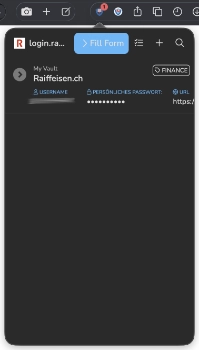
PVYvault incorporates DOM and Clickjacking Prevention features. It identifies instances where an IP address, localhost, or domain corresponds to credentials stored as a PVYvault item, but requires user interaction (button press) to populate the field.
Enter PVYvault: A Fundamentally Different Approach
PVYvault, developed by PVY.swiss AG and available at our Appstore, is not just another password manager. It's a PriVacY-first, zero-knowledge, root-less credential management platform that is architecturally designed to eliminate the attack surfaces that plague conventional password managers.
Key Architectural Differentiators
| Feature | PVYvault | LastPass | Bitwarden | KeePass | Passbolt | NordPass |
|---|---|---|---|---|---|---|
| Deployment Model | Per-customer isolated deployment | Shared cloud | Shared cloud or self-hosted | Local file | Self-hosted or cloud | Shared cloud |
| Network Exposure | PVYvpn only (not publicly reachable) | Public internet | Public internet | Local only | Public internet | Public internet |
| Root-less Deployment | ✅ Yes | ❌ No | ❌ No | N/A | ❌ No | ❌ No |
| CIS2/NIST Compliance | ✅ Yes | Partial | Partial | N/A | Partial | Partial |
| Encrypted Database | ✅ AES-GCM + PBKDF2 + RSA | Yes | Yes (AES-256) | AES-256 | Yes | XChaCha20 |
| Zero Telemetry | ✅ No analytics, no backdoors | Telemetry present | Some telemetry | None | Minimal | Some |
| Per-Customer Isolation | ✅ Hermetically sealed VLAN per customer | ❌ Shared infrastructure | ❌ Shared (cloud) | N/A | ❌ Shared | ❌ Shared |
| Swiss Data Sovereignty | ✅ Swiss datacenter | US-based | US-based | N/A | EU/US | Lithuania |
| Supply Chain Attack Surface | Minimal (no third-party CRM integrations) | High (Klue, Salesforce, Gong) | Moderate | None | Low | Low |
1. Not Exposed to the Public Internet
Unlike LastPass, Bitwarden, NordPass, and most other cloud-based password managers, PVYvault is typically not reachable on the public internet. It is accessible only through PVYvpn, a session-less peer-to-peer VPN with symmetric key exchange. As PVY.swiss states:
"Everything is secured with PVYvpn - a session-less P2P VPN with symmetric key exchange – a truly secure way to manage user data and the flow of data."
This means the attack surface that was exploited in the LastPass/Klue breach — where OAuth tokens were stolen from a third-party integration and used to access customer data — simply doesn't exist in the PVYvault architecture. There are no public endpoints to probe, no OAuth tokens sitting in third-party platforms, no Salesforce integrations to compromise.
2. Each Customer Gets Their Own Isolated Deployment
One of the most critical distinctions is that every PVYvault customer receives their own dedicated deployment. There is no shared database, no shared infrastructure, and no multi-tenant co-mingling of data. Each deployment runs in its own hermetically sealed VLAN, with its own encrypted PostgreSQL database and its own encrypted disk image for attachments.
As the documentation states:
"Each of our Deployment is non-privileged on all Levels. Each Application Stack has its own Network. Each Customer its own VLAN separated hermetically sealed PVY@Cloud or PVY@Home/Office Environment."
This is the polar opposite of the shared-infrastructure model used by LastPass and Bitwarden's cloud offerings, where a single breach can potentially expose data across millions of users.
3. Root-less Deployment Within CIS2 Compliance
PVYvault is deployed using non-privileged containers (non-privileged containerd and non-privileged Docker/Pods), meeting the latest CIS and NIST benchmarks. The documentation explicitly states:
"PVYvault is designed to store top secret information and documents reliably and secure. Its root-less deployment Architecture meets the latest CIS & NIST Benchmarks and AI can't hack it."
CIS Level 2 compliance builds on Level 1 by adding stricter security controls that guard against advanced threats, including mandatory multi-factor authentication and hardened system configurations. This is not a checkbox exercise — it's baked into the deployment architecture from the ground up.
4. Encrypted Database — Even for Local Communication
All data in PVYvault is encrypted at rest and in transit. The cryptographic architecture employs three encryption schemes:
- Simple Symmetric Encryption — AES-GCM with randomly generated keys for ephemeral encryption
- Password-Based Encryption — PBKDF2 key derivation (per RFC 2898) combined with AES-GCM, using the user's master password
- Shared-Key Encryption — RSA public-key encryption (per RFC 7516 / JSON Web Encryption) for securely sharing vault items between multiple users without sharing a common password
The database itself is a PostgreSQL instance where entries are not only hashed but encrypted. Even with physical root access, stored items cannot be queried — only the table structure can be retrieved. Documents and attachments are stored in a special mounted encrypted volume (Encrypted Disk-Image) for each deployment.
Deployment credentials are managed through getops and configu, which issue and rotate credentials on a regular schedule, adding another layer of protection against credential theft.
5. Zero Telemetry, No Backdoors, No Trust Required
Unlike many commercial password managers that collect analytics, telemetry, or usage data, PVYvault sends zero analytics or telemetry data back to PVY.swiss. The documentation is explicit:
"Like every PVYapp, there are no Analytic Data or Telemetry Data being sent back to us. We also can ensure, there are no Backdoors implemented."
Furthermore, PVYvault operates on a no-trust-required principle. Unlike other products, PVYvault does not require explicit trust between the end user and the host. The zero-knowledge architecture ensures all data is encrypted client-side before transmission, meaning even PVY.swiss cannot access your stored secrets.
The Enterprise Administrator Portal explicitly cannot retrieve a user's MasterKey or change their password — this is technically impossible due to the security architecture and encryption design.
Feature-Rich Without Compromising Security
PVYvault doesn't sacrifice usability for security. Here's what you get:
Cross-Platform Support
- Browser Extensions: Chrome, Firefox, Safari, Edge, Opera, Brave, ZenBrowser, Orion
- Desktop Apps: Linux, macOS, Windows
- Mobile Apps: iOS, Android, GrapheneOS, /e/OS
- Progressive Web App with offline/local-first functionality
Authentication & MFA
- Biometric: Windows Hello-ID, macOS Touch ID/Fingerprint, iOS Face ID
- Hardware Keys: Yubikey USB, Google Titan, BitBox02, Kudelsky (FIDO2/WebAuthn)
- TOTP: FreeOTP, Google Authenticator, Authy, and more
- Built-in TOTP for stored objects (share OTP codes with team members)
Vault Object Types
- Website/WebApp, Computer/Server, WiFi Access, Notes (Rich Text & Markdown), Documents, Bank Accounts, Credit/Debit Cards, Passports/ID Cards, Databases, SSH Key Pairs, API Tokens & Secrets, Webhooks, Authenticator entries, and custom-defined types
Organization & Sharing
- Personal Vaults and Organization Vaults
- Multiple Organizations per account
- Granular permissions: Read-only, Can modify, Owner
- Groups and Teams for fine-grained access control
- Organization Dashboard with overview of vaults, groups, and members
Enterprise Features
- Built-in Version Control (ISO 27001 compliant) with full history and revert capability
- Audit Logs for compliance and traceability
- Security Report with HaveIBeenPwned integration (downloaded locally every 30 minutes — your passwords are never uploaded)
- Enterprise Administrator Portal for compliance auditing
- OpenAPI with full documentation
- CLI Tool for terminal-based credential management
- AI Agent & MCP Server integration — leverage your AI agents to store credentials in shared vaults with full history and rotation support
Easy Migration from Any Platform
PVYvault supports import from every major password manager with pre-defined templates:
| Source | Format |
|---|---|
| KeePass | CSV |
| Keyguard | JSON, CSV |
| Bitwarden | JSON |
| Passbolt | CSV |
| NordPass | CSV |
| iCloud | CSV |
| macOS Keychain | CSV |
| Chrome | CSV |
| Firefox | CSV |
| Orion | CSV |
| 1Password | 1PUX, CSV |
| LastPass | CSV |
| Any generic | CSV |
A typical migration takes under 10 minutes.
The Swiss Advantage
PVY.swiss AG is a Swiss company hosting in a Swiss datacenter, which means your data is protected by some of the strongest data protection laws in the world. Switzerland's Federal Act on Data Protection (FADP) and its alignment with GDPR provide robust legal protections. Combined with PVY.swiss's NIS2 compliance offerings, this makes PVYvault particularly attractive for European organizations subject to stringent regulatory requirements.
As PVY.swiss states:
"PVY.swiss offers you all the tools you need to be productive in your work, similar to Google Business or Office365, with the difference that we ensure that your data remains private and is not indexed, or utilized externally."
Why PVYvault Is the Right Choice: A Summary
| Concern | How PVYvault Addresses It |
|---|---|
| Supply chain attacks (like LastPass/Klue) | No third-party CRM integrations; not publicly exposed; accessible only via PVYvpn P2P VPN |
| Shared infrastructure breaches | Each customer gets their own isolated, hermetically sealed deployment |
| Government surveillance / data aggregation | Swiss data sovereignty; zero telemetry; no backdoors; zero-knowledge architecture |
| Weak encryption / offline vault cracking | AES-GCM + PBKDF2 + RSA; encrypted PostgreSQL database; encrypted disk images for attachments |
| Privilege escalation attacks | Root-less, non-privileged container deployment; CIS2/NIST compliant |
| Insider threats | No-trust-required architecture; administrators cannot access user master keys or passwords |
| Vendor lock-in | Full export capability; import from all major competitors |
| Compliance requirements | CIS2, NIST, ISO 27001 (version control & audit logs), NIS2 compliance |
Conclusion
The LastPass Klue supply chain breach and the ongoing fallout from the 2022 LastPass vault thefts demonstrate that the traditional centralized, cloud-hosted, shared-infrastructure password manager model is fundamentally flawed. When your most sensitive credentials are stored on publicly accessible servers alongside millions of other users' data, integrated with third-party platforms like Salesforce and Gong, you are accepting a level of risk that no encryption can fully mitigate.
Bitwarden's $100M growth-equity funding round and the broader industry trend of PriVacY tools accepting investment from entities with surveillance-adjacent business models further erode confidence in the status quo.
PVYvault represents a paradigm shift: a password manager that is not publicly exposed, that gives each customer their own isolated deployment, that is deployed root-less within CIS2 compliance, that encrypts everything — including the database and local communication — and that operates on a zero-knowledge, no-trust, zero-telemetry principle.
Your passwords are the keys to your digital life. Don't store them in a glass house. Store them in a vault.
Sources
[1] BleepingComputer — LastPass confirms data breach in Klue supply-chain attack — https://www.bleepingcomputer.com/news/security/lastpass-confirms-data-breach-in-klue-supply-chain-attack/ [2] PVY.swiss Documentation — PVYvault | Getting started — https://docs.pvy.swiss/en/quickstart/overview/pvyvault [3] PVY.swiss — Main Website — https://www.pvy.swiss/ [4] Tracxn — Bitwarden Funding Rounds & Investors — https://tracxn.com/d/companies/bitwarden/__Wr4BfTdoN3fZLVBG76ljKenhHDOw4MAqh0qseTh1JR4/funding-and-investors [5] Wikipedia — Bitwarden — https://en.wikipedia.org/wiki/Bitwarden [6] PSG Equity — Bitwarden Announces $100 Million Growth Investment — https://psgequity.com/news/bitwarden-announces-100-million-growth-investment-led-by-psg [7] Medium — The Rise of Palantir and Its Impact on PriVacY — https://medium.com/the-watchtower/the-rise-of-palantir-and-its-impact-on-PriVacY-c9c8d915c897 [8] Wikipedia — 2022 LastPass data breach — https://en.wikipedia.org/wiki/2022_LastPass_data_breach [9] The Hacker News — LastPass 2022 Breach Led to Years-Long Cryptocurrency Thefts — https://thehackernews.com/2025/12/lastpass-2022-breach-led-to-years-long.html [10] BleepingComputer — Cryptocurrency theft attacks traced to 2022 LastPass breach — https://www.bleepingcomputer.com/news/security/cryptocurrency-theft-attacks-traced-to-2022-lastpass-breach/ [11] Security